This isn't simply an Excel spreadsheet for recording expenses.
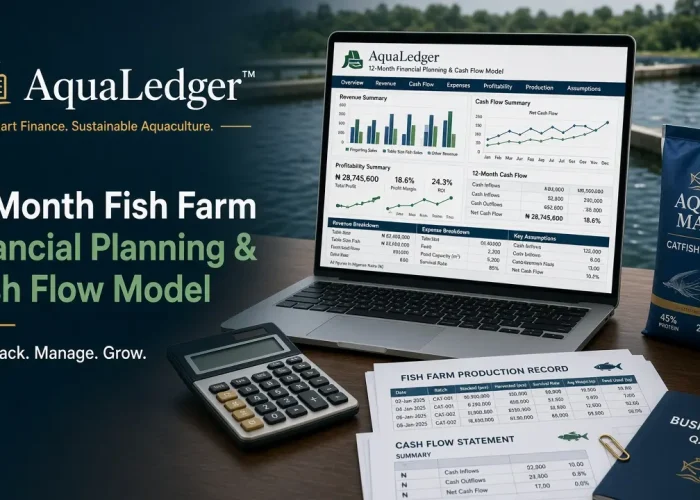
AquaLedger™ is a financial planning model for fish farmers who want to understand how their farm could perform financially before committing more money to the operation.
It allows users to model products, sales timing, mortality, feed and operating costs, startup assets, loans, interest, tax and opening cash—and then automatically see the resulting cash flow, profitability and financial health indicators.
The workbook supports up to six revenue/product lines and multiple operating expenditure items, with editable input cells separated from formula-driven calculations.
That makes the product particularly useful for farm planning, budgeting, funding preparation and financial decision-making.
Your fish farm has a production cycle. Your money has one too.
Before you buy feed, expand your ponds, take a loan, hire workers or increase production, you need to know what those decisions could do to your cash position.
That is where AquaLedger™ comes in.
Designed specifically for fish farming and aquaculture financial planning, this Kmacims EAT Excel model gives you a structured way to translate your farm's operating assumptions into a 12-month financial forecast.
Instead of keeping figures scattered across notebooks, WhatsApp messages and ordinary spreadsheets, you can bring the key financial drivers of your operation into one model.
Enter how much you expect to sell, your selling prices, product launch months and expected mortality. Add feed, water, labour, rent, transportation, marketing, maintenance, insurance and other operating costs. Then enter your startup assets, depreciation assumptions, funding requirements, loan terms, opening cash and tax rate. The workbook automatically feeds these assumptions into its financial statements and dashboard.
What happens next?
Your assumptions flow into a monthly cash flow statement, allowing you to see cash inflows, operating expenditure, capital expenditure, loan repayments, net cash flow and cumulative cash position across the year.
You also get a dedicated Profit & Loss statement that brings together sales revenue, cost of sales, operating costs, depreciation, interest, profit before tax, tax and net income.
And when you don't want to work through every figure, the KPI Dashboard gives you a quick financial health check covering:
Total Year 1 revenue
Gross profit
Gross margin
Operating profit
Net income
Net margin
Capital invested
Opening cash
Ending cash
Loan/peak funding requirement
Built for real planning—not fantasy projections
The workbook also encourages users to stress-test their assumptions by increasing feed costs and reducing selling prices, while reviewing mortality assumptions and validating loan and tax terms.
That's important because a financial model should not merely show you an attractive profit figure.
It should help you ask:
What happens if feed becomes more expensive?
What happens if mortality increases?
What happens if selling prices fall?
When does loan repayment begin?
Will the farm maintain sufficient cash?
How much capital is actually being committed?
Those are the questions that turn a spreadsheet into a decision-making tool.
Whether you're starting a small commercial fish farm, expanding an existing operation, preparing a funding proposal, assessing a new production cycle, or simply trying to understand where your money is going, AquaLedger™ gives you a structured financial model from which to work.
What You Can Model
🐟 Revenue
Model multiple fish products or revenue streams, including different selling prices, quantities, sales start months and mortality assumptions.
The template currently provides space for six product/revenue lines, including optional product slots.
🌾 Feed & Operating Costs
Track major aquaculture costs such as:
Different feed sizes
Water
Deworming
Boosters
Labour
Rent
Marketing
Transportation
Utilities
Maintenance
Insurance
Miscellaneous/logistics
The workbook also provides additional optional expenditure rows for users to customise.
🏗 Startup & Capital Investment
Model investment in:
Fish ponds
Equipment
Machinery
Furniture
Land
Vehicles
Other capital assets
You can enter quantities, purchase prices, depreciation rates and purchase months.
💰 Financing
Model:
Loan amount
Annual interest rate
Funding source
Loan duration
Moratorium period
Monthly interest
Principal repayment
Monthly repayment
Your Financial Command Centre
1. Data Entry: This is where the buyer enters their assumptions.
Yellow cells identify editable inputs, while formula cells calculate automatically. The workbook specifically instructs users not to overwrite formula cells.
2. KPI Dashboard: Get a quick snapshot of your farm's projected financial position without digging through multiple worksheets.
3. Monthly Cash Flow: See how money is expected to move through the business month by month.
This includes:
Cash In → Operating Costs → Capital Expenditure → Loan Repayment → Net Cash Flow → Cumulative Cash Position
4. Profit & Loss: Understand the projected annual profitability of the farm.
The model calculates:
Revenue → Cost of Sales → Gross Profit → Operating Costs → Operating Profit → Interest → Tax → Net Income