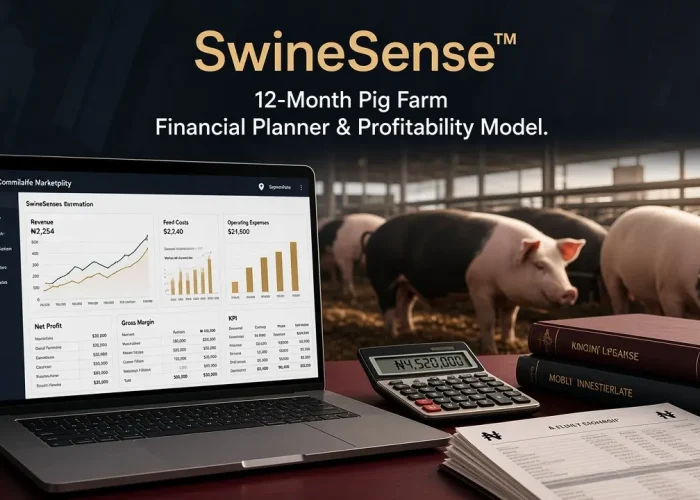
SwineSense™ is an editable Excel financial planning model designed specifically for pig farmers and swine-production entrepreneurs who need to understand the financial consequences of their production, pricing, operating-cost and financing decisions.
Rather than functioning as a simple farm expense tracker, it connects the major financial drivers of a pig enterprise—including mature pig sales, pork sales, mortality, feed inputs, veterinary costs, labour, transportation, marketing, capital expenditure, depreciation, loans, interest, tax and cash position—within one 12-month planning system.
The model allows users to enter their own assumptions and automatically review the resulting cash flow, profitability and financial KPIs.
Turn pig-farming assumptions into financial intelligence.
SwineSense™ is a 12-month Excel financial planning model for pig farmers, swine-production businesses, agribusiness investors and farm managers.
Enter your production, selling prices, mortality, feed and operating costs, capital investments, financing and tax assumptions—and the model helps you see projected revenue, cash flow, profitability, loan obligations and key financial indicators in one place.
Built for Nigerian agribusiness and presented in ₦ Naira.
Your pigs are an asset. Your feed bill is a liability. Your cash flow connects the two.
A successful pig farm needs more than good husbandry.
It needs financial discipline.
That is why SwineSense™ was designed as a practical financial planning model rather than an ordinary farm record spreadsheet.
The workbook gives you a structured environment for modelling the economics of a pig enterprise over 12 months. You can enter multiple revenue items—including mature pigs, pork and optional additional products—and specify quantities, costs, selling prices, sales start dates, growth assumptions, price changes and expected mortality.
Then come the costs—the area where many livestock businesses can quickly lose control.
The model allows you to plan for feed-related inputs such as palm kernel cake, blood meal, cassava peel and maize chaff, alongside firewood, vaccination, veterinary services, water, salaries, rent, marketing, transportation, maintenance, insurance, owner's wage and other custom expenses.
This means you can move beyond the question:
"How much will I sell my pigs for?"
and begin asking:
"What will remain after the costs required to produce and sell them?"
See the Farm Through Four Financial Windows
1. Data Entry — Build Your Scenario
The yellow input cells allow you to enter your own assumptions.
You can customise:
Production quantities
Unit costs
Selling prices
Mortality
Sales start month
Cost growth
Price changes
Operating expenses
Capital assets
Depreciation
Loan amount
Interest rate
Loan duration
Moratorium
Opening cash
Tax rate
The workbook's instructions clearly distinguish editable input cells from formula-driven cells, helping reduce accidental changes to the model.
2. Dashboard — Get the Big Picture
Instead of searching through rows of calculations, the dashboard brings important Year 1 indicators together.
You can review:
Total Sales Revenue
Gross Profit
Gross Margin
Operating Profit
Net Income
Net Margin
Total Capital Invested
Opening Cash
Ending Cash
Loan / Peak Funding
This makes the model useful not only for farmers, but also for entrepreneurs who need a quick financial overview when evaluating a proposed pig-farming operation.
3. Monthly Cash Flow — Find the Cash Pressure Points
Profit and cash are not the same thing.
The Monthly Cashflow sheet lets you examine the movement of money across the year, including sales income, funding, direct and operating costs, capital expenditure and financing-related movements.
This can help users identify months where cash may become tight and where additional working-capital planning may be necessary. The template itself recommends using the monthly cash-flow view to identify negative-cash months and plan appropriate buffers.
4. Profit & Loss — Understand the Bottom Line
The integrated Profit & Loss statement brings the major components together to calculate:
Sales Revenue
→ Cost of Sales
→ Direct & Operating Costs
→ Gross Profit
→ Operating Costs & Depreciation
→ Operating Profit
→ Interest
→ Profit Before Tax
→ Tax
→ Net Income
The workbook also explicitly notes that its interest calculation is an approximation and that actual interest depends on outstanding principal—an important distinction when using the model for real financial decisions.
What Makes SwineSense™ Valuable?
Feed Economics
Model important feed-related inputs and see how changes can affect your financial picture.
Mortality Planning
Account for expected stock losses when projecting saleable revenue.
Price Sensitivity
Adjust selling prices and model different scenarios.
Operating-Cost Visibility
Bring veterinary, labour, water, transportation, maintenance, marketing and other expenses into the same financial model.
Capital Planning
Model assets such as equipment, chambers, boreholes and other startup investments with depreciation assumptions.
Financing
Enter loan amount, interest rate, duration and moratorium assumptions.
Cash Management
Track opening cash, monthly movement and projected ending cash.
Profitability Analysis
See gross profit, operating profit and projected net income.